- Have any questions?
- 051 6112414
- 0331 2220247 | 0334 5510161
- info@psychcaretherapy.com


When Your Mind Won’t Stop Talking: Unpacking the Puzzle of Anxiety

The Chai That Changed Everything
May 9, 2025
Understanding Trauma: A Wound You Can’t See, A Healing You Can Begin
June 22, 2025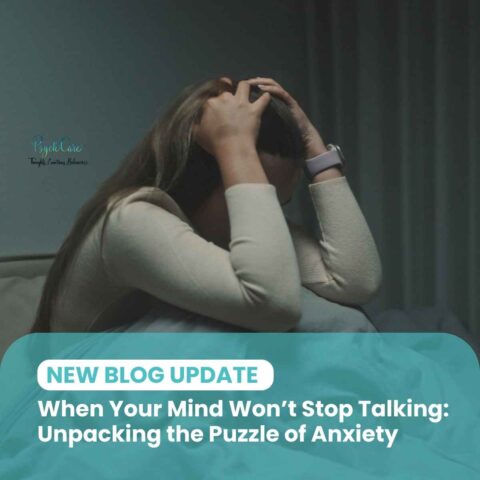
From racing hearts to quiet wars inside our heads—let’s talk about what anxiety really feels like, why it happens, and how therapy offers more than just a fix—it offers freedom.
The Whisper That Becomes a Roar
It starts small.
A tiny flutter in your chest before a meeting. A restless sleep before an exam. The stomach drop when your phone lights up with a message you weren’t expecting.
Anxiety doesn’t always knock loudly. Sometimes, it’s just the feeling that something is about to go wrong—even when everything looks fine. Like a background app draining your battery, it hums below the surface, unnoticeable until you’re running on empty.
But here’s the twist: anxiety isn’t just a feeling. It’s a full-body experience. A state of high alert that rewires how we see, feel, and react to the world around us.
What Anxiety Actually Is (And What It Isn’t)
Let’s bust a myth right away: anxiety is not a weakness.
It’s your brain doing its job—just a bit too well.
Anxiety is the brain’s fire alarm. The system designed to protect you from danger, triggered by stress or perceived threats. Only problem? Sometimes it can’t tell the difference between a tiger and a traffic jam. Between being humiliated or being unsafe.
Common symptoms of anxiety:
- Racing heart and shallow breath
- Restlessness and irritability
- Overthinking or intrusive thoughts
- Sweating, trembling, or dizziness
- Muscle tension or jaw clenching
- Trouble sleeping or constant fatigue
- Avoidance of situations or people
But here’s the kicker—it doesn’t look the same for everyone.
For one person, it’s a panic attack that hits like a storm. For another, it’s chronic indecisiveness and people-pleasing. Some are loud worriers; others are calm on the outside and in chaos on the inside.
“I Didn’t Know It Was Anxiety” — A Client’s Story
I remember one of my therapy clients, let’s call her Zara. She walked in saying she needed help with “focus issues.”
She was smart, articulate, and always smiling. But she hadn’t slept well in years. She double-checked every email five times. She couldn’t say no without guilt. When someone didn’t text back, she’d replay their last conversation, sentence by sentence, for hours.
Zara didn’t realize that she wasn’t just “too sensitive” or “bad at relaxing.” She had high-functioning anxiety. A term that isn’t a formal diagnosis but describes the silent struggle of looking like you have it together while falling apart inside.
Therapy helped her name it. And naming it changed everything.
The Science of What’s Going On
Let’s go inside the brain for a moment.
Anxiety is largely a dance between two key parts of the brain:
- The amygdala, our emotional alarm system
- The prefrontal cortex, our logic and reasoning hub
In anxiety, the amygdala overreacts, and the prefrontal cortex can’t keep up. Your body gets flooded with stress hormones (like cortisol and adrenaline), and suddenly, you’re in fight-or-flight mode—without any actual danger.
It’s like your brain is yelling, “Run!” while your life is whispering, “You’re safe.”
Why It Shows Up
Anxiety has many faces, and it rarely comes without a reason. Some common triggers:
- Genetics: If your parents struggled with anxiety, your brain might be wired similarly.
- Trauma or chronic stress: A history of bullying, abuse, neglect, or unpredictable environments
- Perfectionism: A deep-rooted fear of failure or disappointing others
- Big life changes: New job, new city, relationships ending or beginning
- Health conditions: Thyroid issues, hormonal changes, or even blood sugar crashes
But sometimes? It just arrives. Like uninvited guests in your living room. And suddenly, you’re rearranging your life around them.
What Healing Actually Looks Like
Healing from anxiety isn’t about “getting rid of it.” It’s about understanding it—learning how to live with it, not under it.
Here’s how therapy helps:
- Cognitive Behavioral Therapy (CBT)
One of the most evidence-based approaches, CBT helps identify unhelpful thought patterns and reframe them. Think of it as cleaning out the mental clutter that fuels anxious spirals.
Example: “What if I mess up the presentation?” becomes “Even if I stumble, I’ve prepared well and I can recover.”
- Mindfulness and Grounding Techniques
These tools bring you back to the present—where anxiety loses its grip. Breathing exercises, body scans, and even naming five things you can see/hear/touch in the moment can bring immediate relief.
- Exposure Therapy
This doesn’t mean being thrown into the deep end. It means slowly and safely facing what you fear, until it loses its power. Think: practicing small talks before public speaking.
- Inner Child Work and Trauma Therapy
Sometimes, anxiety is rooted in unmet needs from the past. Therapy creates a space to process those wounds—often for the first time.
“I wasn’t allowed to express fear as a child. No wonder I panic now when I feel unsure.”
- Medication (when needed)
For some, medication is a bridge—a way to regulate the nervous system while therapy does its work. It’s not the easy way out. It’s often the first step to feeling stable enough to begin the deeper work.
The Quiet Victories That Go Unseen
Healing anxiety is not loud or dramatic. It’s not always in breakthroughs—it’s in the quiet wins.
- Saying “no” and not feeling guilty
- Going to bed without needing a podcast to distract your thoughts
- Ordering at a restaurant without rehearsing
- Not checking your phone every 2 minutes
- Leaving the house without triple-checking everything
These might look ordinary from the outside. But to someone living with anxiety? They’re mountains moved.
Let’s Stop Saying “Just Calm Down”
Anxious people are not overreacting. They’re over-processing. And what they need most isn’t fixing—it’s safety.
If someone in your life is anxious, here’s what helps more than advice:
- “I’m here with you.”
- “Let’s take one breath at a time.”
- “You’re not alone in this.”
- “It’s okay to not have it all figured out right now.”
Being a safe person matters more than having the perfect words.
The Therapist’s View—A Note from the Couch
As a therapist, I’ve sat across clients in every shade of anxiety—from teens afraid of judgment to adults paralyzed by decision-making. And the one thing I’ve learned?
Anxiety isn’t the enemy.
It’s a signal. A messenger. A wounded part of you asking, “Am I safe? Am I enough? Can I let go now?”
And every time someone walks into therapy ready to listen to that part—change begins.
It’s not overnight. But it’s real.
You Are Not Broken. You Are Becoming.
Anxiety doesn’t mean you’re broken. It means you feel deeply. You care. You’re wired to protect yourself.
The goal isn’t to silence your anxiety completely.
It’s to become the kind of person who can hear the fear—and still choose courage. Who can sit with discomfort and not crumble. Who can hold their own hand and say, “I’ve got me.”
That’s not just healing. That’s freedom.
Need Support? Let’s Talk
If anxiety is getting in the way of your joy, relationships, or daily functioning, know that you don’t have to do this alone.
Therapy at PsychCare is tailored to meet you where you are—with empathy, proven tools, and a safe space to breathe again.
Let’s turn down the noise in your head—and tune into the life that’s waiting on the other side of fear.