- Have any questions?
- 051 6112414
- 0331 2220247 | 0334 5510161
- info@psychcaretherapy.com


Bipolar and Insomnia — I Don’t Feel Better When I Sleep More

‘If He Wanted to, He Would’ Is Ableist Relationship Advice
April 19, 2023
I Self-Diagnosed; I Have Undiagnosed Mental Illness
April 19, 2023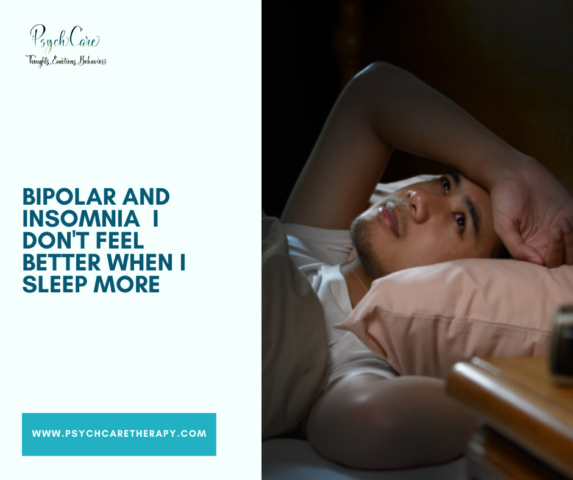
Insomnia is common in bipolar disorder. Sleep changes (which can be insomnia or hypersomnia [oversleeping]) are noted in the symptoms of major depressive disorder, which is part of bipolar disorder. In fact, I would wager that without medication, every person with bipolar disorder would have sleep problems. In my case, I have insomnia with my bipolar disorder and have had it for three years. But last night, I was lucky. Last night I managed to sleep almost eight hours (interrupted, but still). So, why don’t I feel any better?
Dealing with Bipolar and Insomnia
Every night, I work very hard, trying to go to sleep and stay asleep. It’s actually a lot of work, dealing with insomnia and bipolar. It involves a nighttime schedule, medication, relaxation exercises, creating the right bedroom environment, and anti-anxiety techniques. It’s all a significant pain. I remember when I used just to sleep when I was tired. It’s so much more complicated now.
However, I would always say that dealing with your sleep is critical to successful bipolar management. If you don’t optimize your sleep and circadian rhythm, you just won’t get and stay well. (Not to mention that a change in sleep often indicates a change in your bipolar disorder, and it’s critical to recognize that as well.)
Effects of Insomnia on Bipolar Disorder
It’s no surprise that having insomnia makes a person feel like crap. If you’re getting five-six hours of sleep every night instead of eight, you’re going to feel it, and it’s not going to feel good. And in the long term, these feelings just get worse and worse.
In my case, not getting enough sleep worsens my bipolar disorder symptoms and creates more significant anxiety daily. I would do anything to get rid of my insomnia if for no other reason than to help my bipolar disorder.
A Good Night’s Sleep Despite Insomnia and Bipolar Disorder
As I said, last night, I actually did get some sleep. I got more sleep last night than I have in months. Today, I feel just as exhausted and depressed as I always do. That extra sleep seems to have done nothing.
I suspect this is actually because of something known as a cumulative sleep deficit, also known as sleep debt. This is the sleep deficit you build up over time when you don’t sleep enough.1
For example, if on night one, you’re short one hour of sleep, your sleep deficit is one hour. If, on night two, you’re short two hours of sleep, now your sleep debt is three hours, and so on. In my case, over a week, my cumulative sleep deficit is likely 14+ hours. I do not wish to calculate how much of a sleep deficit I’ve created over years.
So, when fighting insomnia with your bipolar disorder, not only do you have to worry about last night’s sleep, but you have to worry about taking your sleep deficit into account, too.
In other words, one night of good sleep isn’t going to cut it if you’ve had years of insomnia, like me.
Cumulative sleep deficits aren’t reduced one-to-one over the course of years.1 That’s not the point. The point is that a cumulative sleep deficit is a real thing and is likely why one good night of sleep doesn’t correct a problem that has occurred over years. I find this discouraging, of course, but it is logical.
That said, all hope is not lost. Perhaps one good night of sleep can lead to another. And maybe they can lead to more. And over time, maybe I can take a bite out of my enormous sleep debt. I guess the important thing is to do the best I can every night.
Courtesy: www.healthyplace.com
Interested In: ‘If He Wanted to, He Would’ Is Ableist Relationship Advice