- Have any questions?
- 051 6112414
- 0331 2220247 | 0334 5510161
- info@psychcaretherapy.com


The Grandfather I Never Met, Yet Grew Up Knowing

Internships, Case Counts, and the Psychology of “We’re Doing You a Favour”
January 22, 2026
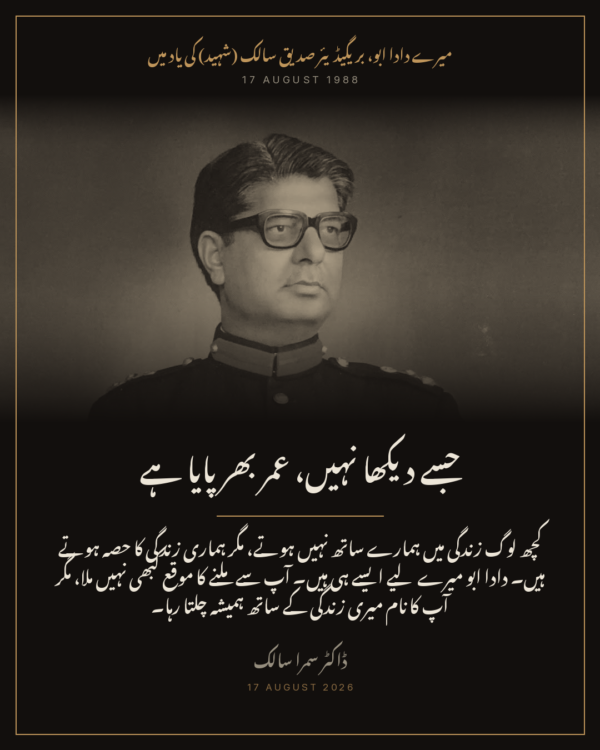
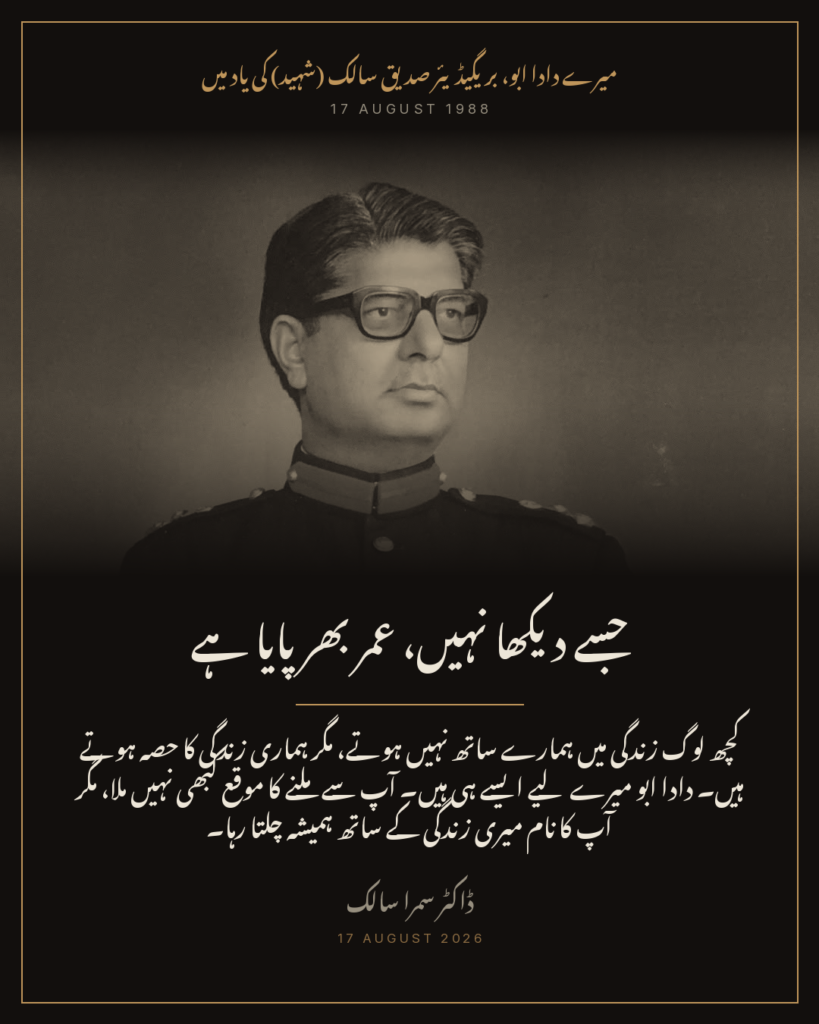
جسے دیکھا نہیں، عمر بھر پایا ہے
August 17, 2026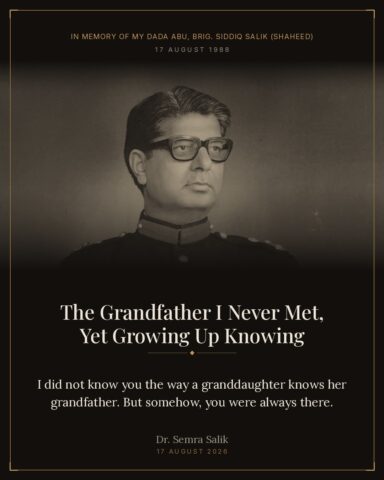
In memory of Brigadier Siddiq Salik · 17 August 1988
My grandfather, Brigadier Siddiq Salik, was martyred in the Bahawalpur plane crash on 17th of August 1988, four years before I was born. I never had the chance to meet him, hear his voice, or know what it felt like to sit beside him. And yet, in a strange way, I grew up knowing him.
Some relationships, I have learnt, do not need a meeting to exist. They find their way into your life through stories, photographs, books, people and the little things that remain behind. Dada Abu was one such presence in my life.
For many, Brigadier Siddiq Salik was a senior military officer, former Director General ISPR, a renowned Pakistani writer and an important name in the country’s military and literary history. For me, he was simply Dada Abu. The respect his name carried was something I understood only gradually, as I grew older.
As a child, I never quite understood the expressions that followed my name. Every year, when school began and introductions were made, someone would hear “Salik” and pause. Then came the inevitable question: “Brigadier Salik?” And there would be a certain smile or expression on the other side that I could never quite understand.
My teachers would sometimes look at my language papers and say, “There is a literary germ in you.” At the time, I thought it was simply something teachers said. Only much later did I begin to wonder if perhaps they were seeing a little of someone in me whom I had never even met.
Every year, 17th of August was a quiet day in our home. It was sad, but it was also filled with a strange sense of pride. People would come for dua. Some were familiar, many were not. They would sit with us, share a memory of Dada Abu, tell us how they had known him or how their lives had crossed his at some point, and then leave.
As children, we simply grew up with this ritual. Later, as we grew older, our own friends and circles became part of it too. Somehow, 17th of August became the one day when school, university and eventually work could be put aside without explanation. We gathered, prayed and remembered.
And every year, I found myself praying for someone I had never known personally. That was perhaps the strangest part of my grief: I missed someone I had never had.
Over time, I began to understand that it is possible to grieve a relationship you never got to have.
I have always had a certain fascination with the armed forces. Perhaps Dada Abu was the reason. Years later, when I was about to join a Forces university, I met a retired officer before I formally became part of it. He heard my name and asked, “Salik?”
I said yes.
He smiled and said, “Shoes too big to wear.”
That one sentence explained years of things I had never understood. The pauses. The smiles. The respect that seemed to appear whenever someone realised whose granddaughter I was. For the first time, I understood that the name I had simply grown up carrying was, for many others, a name attached to a history.
Over the years, my professional life brought Dada Abu back to me in the most unexpected ways. I met people who had worked with him, served under him, known him professionally, or belonged to his literary circle. Some remembered him as an officer; others spoke of his kindness, his guidance and his ability to mentor people.
One of my senior colleagues, who had worked directly under him during his tenure as DG ISPR, once shared a story about the day Dada Abu left for Bahawalpur. There was some work that had not been completed, and when someone expressed concern, Dada Abu reportedly said, “Don’t worry. Mountains won’t fall if this doesn’t happen.”
And then, of course, the mountains did fall.
Another memory came much later, in my clinical practice. A couple came to see me because the wife had been struggling with anxiety and panic. As she spoke about when it had begun, she described 17th of August 1988.
They had been deputed to Bahawalpur to look after the delegation. The visit had concluded, they had returned to their room and thanked Allah for its safe completion. Such visits carried enormous responsibility and pressure. A few minutes later, they learnt about the crash.
She did not know what that date meant to me.
For a moment, I was no longer just listening to a clinical history. The date, the place and the story brought a flood of images and feelings I had never expected to encounter in my professional life. I composed myself, completed the session and later referred her to another professional.
That experience stayed with me. It made me realise that grief can have many layers. Some grief is personal. Some is inherited through stories. And some carries a strange mixture of sadness, pride, honour and a longing for someone you never had the chance to know.
Perhaps the person who taught us most about Dada Abu was my father. He raised us with the principles he had learnt from his own father—about right and wrong, responsibility, dignity, self-respect and doing what is right even when nobody is watching. My father was never someone who spoke very openly about his emotions, especially when it came to his father. But on one of Dada Abu’s death anniversaries, he wrote a newspaper article titled “Ahwaal-e-Ishq Jo Mujh Se Rooth Gaya.”
That article said what he rarely said aloud.
I have read it countless times. And each time, I find something new in it—the love of a son for his father, the loss of a relationship interrupted too soon, and an affection that never really found an ending.
Dada Abu’s presence has always been part of our home too. His large portrait still hangs at the entrance of our house. His library still exists—the same place where he wrote. As a child, I would spend my summer holidays sitting there, reading his books.
At the time, it was simply something I loved doing. Today, those memories mean much more.
His books have remained a very special part of my relationship with him. Even now, when there is a special occasion or a meaningful meeting where I have the opportunity to give someone one of Dada Abu’s books, there is a feeling I cannot quite explain. It is a quiet happiness, a sense of pride, and something deeply personal. Perhaps because I remember being that child sitting in his library during summer holidays, reading those very books.
The manuscripts in his handwriting, his uniforms, his sherwanis, his coats and so many other things have also remained with us. As children, we did not always understand why my grandmother was so upset when something belonging to him was damaged or broken. A child thinks a broken object can simply be replaced.
Growing up teaches you otherwise.
You begin to understand that sometimes it is not the object that matters. It is everything attached to it.
Even the crockery bearing Dada Abu’s initials is brought out only on special occasions. These things may seem ordinary to someone else, but to us they carry a piece of someone who is no longer here.
One 17th of August became particularly special in my own life. I received my PhD merit list that day and stood second. It was also the day I successfully defended my MS thesis. Our family had gathered for Dada Abu’s dua, and I remember my mother and grandmother telling the guests about my achievement.
It was a strange and beautiful coincidence. The date that had brought such an enormous loss to our family had also become a date carrying one of my own happiest moments.
While working on my PhD thesis, I thought about Dada Abu often. Perhaps because writing a thesis felt, in its own way, like writing a book. And when the time came, dedicating it to him felt natural.
To the grandfather I had silently wished to meet all my life.
Today, people often know me as Dada Abu’s granddaughter. Perhaps that is one of the most beautiful things attached to my name. I know I cannot fill his shoes. Those were his footsteps, his life and his journey. Mine is my own.
But the values I carry, my love for books and writing, my respect for responsibility, and the importance I place on doing meaningful work all have roots in the family he left behind.
I have spent much of my life discovering Dada Abu in pieces — in the expressions on people’s faces when they heard my name, in the stories of people who had known him, in my father’s quiet words, in my grandmother’s attachment to the things he left behind, in the books I read during childhood summers, in the library that still exists, in the portrait at the entrance of our home, and every year, on the 17th of August, in the dua we make for him.
I often wonder what my relationship with Dada Abu would have been like had I been given the chance to meet him. What would he have thought of me? What would we have talked about? Would he have liked the person I became?
I will never know.
But perhaps, in some way, I have spent my life trying to answer that last question for myself. And perhaps that is what it means to grow up with someone you never met—to carry a quiet wish to make them proud, even when you can never hear them say that they are.
Dada Abu, I never got to meet you. But I grew up surrounded by your name, your books, your stories and the love and respect people carried for you. I did not know you in the way a granddaughter knows her grandfather. But somehow, you were always there.
May Allah accept Dada Abu’s martyrdom, elevate his ranks, fill his resting place with light and mercy, and give us the strength and wisdom to carry forward the values he left behind. Ameen.
Dr. Semra Salik
Granddaughter of Brigadier Siddiq Salik